


The Cohesion Fund was established under the provisions of Article 161 of the Treaty establishing the European Community. The legal act establishing the Cohesion Fund is Council Regulation (EC) No 1164/94 of 16 May 1994, as amended by Council Regulations (EC) No 1264/99 and No 1265/99. As an instrument of the economic and social cohesion policy of the European Union, the Cohesion Fund pursues two primary objectives:
- reducing disparities between the levels of development of the various regions,
- reducing the backwardness of the least favored regions.
The realization of the above objectives is possible thanks to the co-financing by the European Union of projects in the fields of the environment and transport infrastructure. In the field of environmental protection, the core priorities implemented with support from the Cohesion Fund are:
- improving the quality of surface waters,
- improving the quality and distribution of water intended for human consumption,
- improving air quality,
- rationalizing waste management,
- protecting the earth’s surface,
- ensuring flood safety.
The scope of the Cohesion Fund covers assistance of national rather than regional scale, as is the case with structural funds. The Cohesion Fund also differs from structural funds in the way decisions are taken to co-finance a project. In the case of the Cohesion Fund, the decision is taken by the European Commission, while the competence of the country applying to the fund is limited to presenting proposals for co-financing. In the case of structural funds, the decision to grant financial support to a project is taken at the Member State level.
Cohesion Fund resources are targeted at Member States whose gross national product (GNP) per capita is less than 90% of the European Union average, and which have developed a programme aimed at meeting the convergence criteria set out in Article 104 of the Treaty establishing the European Community. In accordance with the co-financing rules applicable to structural policy, assistance from the Cohesion Fund for a specific project will amount to a maximum of 80% to 85% of eligible costs. The remaining minimum of 15% must be provided by the beneficiary.
The Cohesion Fund budget for the years 2000-2006 amounts to EUR 18 billion. Upon the enlargement of the European Union, as of May 4, 2004, the 10 new Member States can also benefit from the Cohesion Fund. The allocation of resources among the new Member States is as follows: Poland 49%, Hungary 13%, the Czech Republic 11%, Lithuania 7%, Slovakia 7%, Latvia 6%, Estonia 4%, Slovenia 2%, Cyprus 1%, Malta 0.26%.
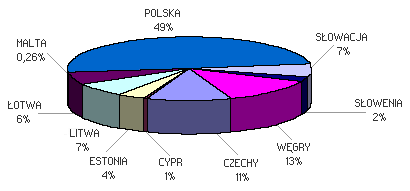
Allocation of Cohesion Fund resources among the new Member States for the years 2004-2006
Source: “Handbook for Cohesion Fund Beneficiaries in the Environmental Sector”,
prepared by the Ministry of the Environment, April 2005.
The allocation of Cohesion Fund resources is carried out on the basis of objective criteria: population, GNP per capita, land area, and identified infrastructure deficits in a given country.
About the Project
Project Title: “Water and wastewater management programme in the Słupsk region” – an enterprise of “WODOCIĄGI SŁUPSK” Spółka z o.o. co-financed by the COHESION FUND
Project Objectives
The primary objective of the enterprise “Water and wastewater management programme in the Słupsk region” is to improve the state of the natural environment, water and soil cleanliness, and to adapt the water and wastewater management of the city of Słupsk, the Słupsk municipality, and the Kobylnica municipality to the requirements of Poland and the European Union. The implementation of this project will also contribute to achieving the objectives formulated by the environmental policy of the European Union, i.e., protecting, preserving, and improving the quality of the environment, protecting human health, as well as the prudent and rational utilization of natural resources.
Project Scope
As part of the “Water and wastewater management programme in the Słupsk region”, the following investment projects will be undertaken:
- modernization and expansion of the wastewater treatment plant in Słupsk,
- construction of a new water treatment station in Słupsk,
- construction of the main sewage transport system to the wastewater treatment plant in Słupsk,
- organization of wastewater management in Słupsk,
- construction of a sanitary sewage network in the Słupsk municipality and the Kobylnica municipality.
Expected Results
The result of implementing the above investments will be the ability to serve all residents of the city of Słupsk and the municipalities of Słupsk and Kobylnica via a collective sewage system. Currently, the sewage system covers 75% of residents in the Słupsk municipality and 65% in the Kobylnica municipality. However, a significant portion of the collected wastewater is treated in local wastewater treatment plants, which are in poor technical condition, and the level of treatment does not ensure compliance with national and European Union legal standards. All wastewater from the collective sewage system of these municipalities will be treated at the main wastewater treatment plant in Słupsk. Following its modernization, the treatment plant will treat all wastewater generated within the municipalities covered by the project to the required standard. The generated sewage sludge will be fully composted and utilized as an organic fertilizer.
The implementation of the “Water and wastewater management programme in the Słupsk region” will also eliminate an existing shortcoming of the Słupsk sewage system, which is that nearly all wastewater from the city reaches the treatment plant through the main pumping station, which is already severely depleted. In the event of a pumping station failure, untreated wastewater would discharge directly into the Słupia River. Creating a new sewage transport system to the treatment plant will protect significant areas of the city and municipality of Słupsk, Ustka, and the Baltic Sea from a realistic sanitary hazard. Furthermore, the construction of a new water treatment station will ensure that all residents receive water quality that complies with European Union standards.
Cost and Funding Amount
The amount of expenditures directly related to the project implementation (planning, programming, land acquisition, construction, equipment, project management) was calculated at EUR 19,597,010. The European Union’s share in financing the “Water and wastewater management programme in the Słupsk region” stands at 70% and amounts to EUR 13,717,907.
The contract “Expansion of the wastewater treatment plant”, the contract “Construction of the sewage system in Słupsk”, as well as Contract No. 03/II/part 2/2009 entitled “Construction of a sanitary sewage network in the Kobylnica Municipality” and Contract No. 03/I/part 4/task 1 and task 2 entitled “Construction of a sanitary sewage network in the Słupsk Municipality” were co-financed by the Voivodship Fund for Environmental Protection and Water Management in Gdańsk.
Project Implementation Unit (PIU)
Sekretariat Spółki
tel. (059) 842-60-51 wew. 301
tel. (059) 842-29-63
sekretariat@wodociagi.slupsk.pl
Measure Authorising Officer (MAO)
(Pełnomocnik ds. Realizacji Projektu)
Andrzej Wójtowicz
tel. (059) 841-83-01
a.wojtowicz@wodociagi.slupsk.pl
Kancelaria JRP
tel. (059) 841-84-00
fax. (059) 840-00-39
jrp.kancelaria@wodociagi.slupsk.pl
PIU ManagerAndrzej Mielczarek
tel. (059) 841-83-90
jrp.amielczarek@wodociagi.slupsk.pl
a.mielczarek@wodociagi.slupsk.pl