


The core business of “Wodociągi Słupsk” Sp. z o.o. consists of:
- water abstraction from underground sources, its treatment, and the collective water supply to Customers in the City of Słupsk and the Municipality of Kobylnica;
- collective discharge of municipal wastewater from the territory of the City of Słupsk, the Municipality of Kobylnica, and the Municipality of Słupsk, and its subsequent treatment at the municipal wastewater treatment facilities in Słupsk.
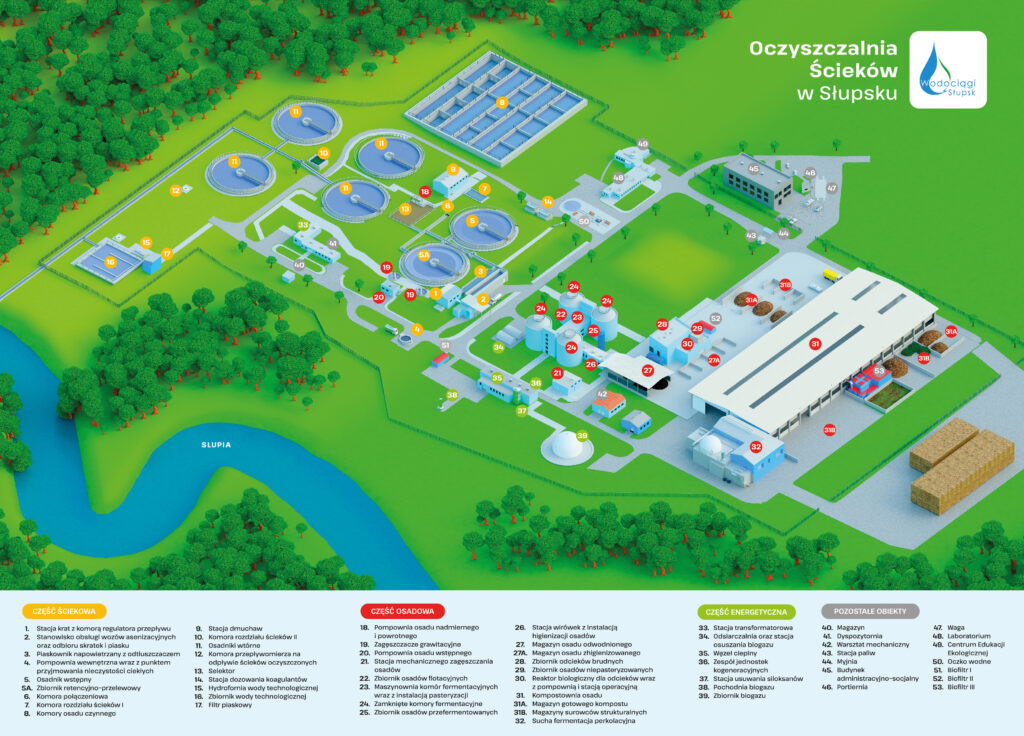
Wastewater from the territories of the three aforementioned local governments is directed to the Wastewater Treatment Plant at ul. Sportowa in Słupsk. The plant was commissioned in 1986, following a 16-year implementation process. Today, it is a thoroughly modernized facility, put into operation after a comprehensive reconstruction of the wastewater treatment section in June 1998. It operates as a mechanical-biological treatment plant. The target pollutant load capacity of the plant corresponds to 230,000 PE (Population Equivalent), while the target average daily flow rate is approximately 28,200 m³ of wastewater per day.
During the municipal wastewater treatment processes at the plant, waste is generated, primarily consisting of:
- screenings in the form of solid matter separated from the incoming municipal wastewater at the beginning of the technological system by devices called screens (approx. 250 tonnes annually);
- grit from the grit chamber – mineral fractions separated from the municipal wastewater using a device called a grit chamber (approx. 100 tonnes annually);
- stabilized municipal sewage sludge (approx. 10,000 tonnes annually).
The latter constitutes the largest share of waste generated at the wastewater treatment facilities in Słupsk. It is precisely this sewage sludge that keeps plant operators awake at night across Poland, not just in our region. The necessity to manage this waste means finding a solution that allows for its utilization in an environmentally safe manner.
According to the applicable Waste Act of December 14, 2012 (Journal of Laws 2013, item 21), municipal sewage sludge is defined as sludge originating from digestion tanks and other installations used for treating municipal wastewater and other wastewater with a composition similar to that of municipal wastewater (Article 3, Paragraph 1, Point 4).
In layman’s terms, municipal sewage sludge is waste generated as a result of treating municipal wastewater in municipal wastewater treatment plants or other facilities mentioned above. It serves as a rich reservoir of valuable fertilizer nutrients, such as nitrogen and phosphorus. However, it is also a potential source of health-hazardous agents (mainly heavy metals), as well as pathogenic organisms contained in municipal wastewater.
As the generator of this waste, “Wodociągi Słupsk” is obligated to manage it in a way that ensures the protection of human life and health, as well as the protection of the environment.
The first step toward meeting these conditions was the construction of anaerobic digestion tanks. Currently, the company operates three Anaerobic Digestion Tanks (ADTs), with a fourth tank currently in the design phase. In these facilities, the sludge undergoes a process of anaerobic digestion. This aims to reduce the volume of the generated sludge and achieve its so-called stabilization – meaning bringing it into a safe form for further processing. Additionally, following the digestion processes in the ADTs, the sludge is dewatered using decanter centrifuges. Our facility generates approximately 10,000 tonnes of sludge with a moisture content resulting in approximately 21% dry matter. Thus, once the sludge passes through the centrifuges, it is prepared for further management.
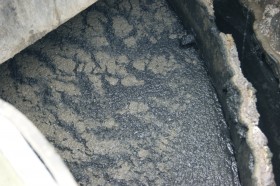
Unstabilized sludge
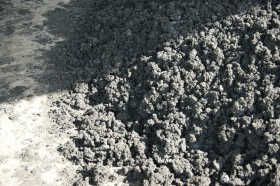
Stabilized sludge (post-ADT)
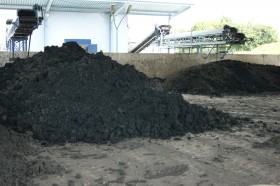
Dewatered sludge storage
There are several options for managing this sludge, including incineration. However, the Management Board of “Wodociągi Słupsk” Sp. z o.o. has chosen to focus on composting as the primary waste management route, while pointing to agricultural application or, incidentally, transferring it to another authorized entity for disposal as viable alternatives.
THE COMPOSTING PLANT
Since 1996, a composting facility for biodegradable waste—including stabilized municipal sewage sludge combined with green waste—has been operating alongside the Wastewater Treatment Plant.
- In 1996, the first composting trials were conducted, adhering to technological standards of so-called controlled composting.
- 1998–2000: Semi-technical scale processing.
- 2000 and 2003: Full technical scale implementation with a roofed installation.
- September 2011: Installation of a deodorization system to eliminate malodorous gases (wet deodorization).
- June 2012: Modernization of the composting pad—installation of an aeration system for the windrows to mitigate odor nuisances stemming from the composting processes (improving windrow-level reactions).
- May 2013: Trials of dry deodorization (the latest and relatively cost-effective deodorization technology).
The Słupsk composting facility is an open-air yet roofed installation. It features a hardened surface in the form of a reinforced concrete pad laid on the ground, equipped with a compost windrow aeration system, a leachate drainage system, and a deodorization system. The entire facility covers 1.5 hectares, with the roofed section spanning 0.91 hectares. This facility is tailored for the biological processing of approximately 20,000 tonnes of waste subject to aerobic decomposition by microorganisms, including around 13,000 tonnes of sewage sludge, operating via turned windrow technology. The remaining portion consists mainly of structural waste sourced from third-party producers in the form of straw, branches, and bark.
The waste designated for recovery, its storage locations, and the treatment processes are specified in the applicable 2010 decision issued by the Marshal of the Pomorskie Voivodeship—a waste generation permit that accounts for waste recovery under process R3 within the composting facility.
As a result of these processes, a fully fledged product is created—an organic fertilizer-compost authorized for marketing under a 2004 permit granted to the Company by the Minister of Agriculture and Rural Development, holding the official status of the “BIOTOP” organic fertilizer.
Composting – Method R3 – Recycling or reclamation of organic substances which are not used as solvents (including composting and other biological transformation processes). This method relies on waste composting processes, i.e., combining stabilized municipal sewage sludge with readily biodegradable organic waste. At appropriate levels of temperature and moisture, aerobic decomposition takes place through the action of microorganisms. Composting is a waste stabilization method that reduces the biologically unstable organic fraction and provides waste sanitation. The heat generated during the composting process, alongside antibiotics produced by the metabolism of fungi omnipresent in composting, leads to thorough sanitization—meaning the elimination of pathogenic organisms—within the composted material.
SIMPLIFIED DESCRIPTION OF THE WASTE COMPOSTING TECHNOLOGICAL PROCESS AT THE SŁUPSK COMPOSTING PLANT
STAGE I – INPUT MATERIALS (Waste Reception and Storage)
Waste and components designated for composting:
- Internal waste generated by “Wodociągi Słupsk” – stabilized municipal sewage sludge and energy willow from the company’s own plantation;
- External waste sourced from third-party producers (straw, wood chips, bark, branches);
- Other waste – in compliance with the permit issued by the Marshal of the Pomorskie Voivodeship for waste recovery under process R3.
The reception of waste for recovery at the composting facility takes place at the waste reception point located next to the Wastewater Treatment Plant. The facility is equipped with a truck scale (weighbridge) integrated with a computerized system for weighing and maintaining records of delivered raw materials. At this stage, verification takes place, including checking the contractor, the carrier, the origin of the material, its type, and its mass. The weighbridge operator weighs the load and directs the supplier to the proper storage area designated for that specific type of waste. A weigh ticket serves as confirmation of raw material acceptance.
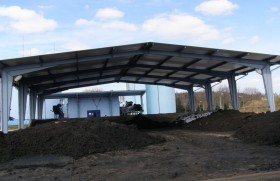
Stage I – Sludge storage next to the composting pad
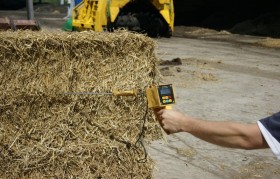
Stage II – Moisture control of the straw
STAGE II – CONTROL OF COMPOSTING COMPONENTS
To ensure that the composting processes proceed correctly, every waste type included in the compost mixture undergoes internal control and verification. Depending on the waste type indicated below, this is carried out as follows:
- stabilized municipal sewage sludge – sample collection for testing is carried out by the employees of “Wodociągi Słupsk” in accordance with the sludge sampling manual; testing is performed under strict protocols at the laboratory located at the Wastewater Treatment Plant in Słupsk, following an established schedule for parasitological and physico-chemical contaminants;
- straw – inspection takes place directly at the time of reception, focusing primarily on moisture content and the pressing/baling method;
- wood chips, bark, and branches – inspection takes place directly at the time of reception and is mostly visual, ensuring the cleanliness of these wastes (checking whether they are properly segregated and free of other undesirable contaminants);
- other waste compliant with the permit issued by the Marshal of the Pomorskie Voivodeship for waste recovery under process R3 – depending on the waste type, either a visual or laboratory inspection is performed.
STAGE III – ESTABLISHING THE STARTING WINDROW
The composting facility is split into two symmetrical areas. Each area contains four lanes, with each lane matching the width of a single windrow and extending the entire length of the facility. Out of these four lanes, two are equipped with an aeration and suction system designed to optimize the biological processes occurring inside the windrows.
Every two weeks (on one section of the pad), a starting windrow is established in the first innermost lane as follows: straw bales are distributed evenly across the entire length of the lane—matching the exact width of a single windrow and the full length of the facility—in line with the proportions established for the compost mixture. This is done by a loader operator using a wheel loader equipped with an integrated electronic scale. Following this, the straw undergoes an initial mixing and fluffing process. Next, a pre-weighed batch of shredded branches is added, and the mixture is blended once again. A groove is then formed along the top of the windrow to accommodate the designated batch of sewage sludge. Once the proper amount of sludge is distributed evenly along the entire length of the windrow, the mixture is blended using a compost turner. For the next several days, the windrow undergoes intensive turning, and its temperature is strictly monitored.
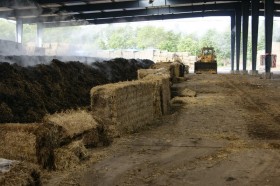
Stage III – Establishing the starting windrow
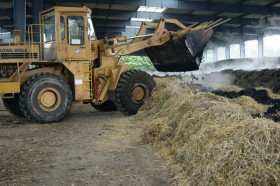
Stage IV – Creating the so-called extension (addition)
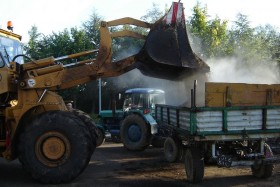
Stage V – Distribution of Biotop
STAGE IV – SUBSEQUENT WINDROWS, THE SO-CALLED EXTENSIONS (SIDE-SHIFTING)
Every two weeks, the windrows are moved using a side-shifting attachment on the compost turner, which enables automatic lateral displacement during the turning process (the so-called side-shift turning). This windrow migration continues from the moment the starting windrow is established until the 8-week-old windrow is merged with the 7-week-old one. The merged windrow remains in the final, fourth lane for a period of 1 week to mature. During this time, a laboratory test is conducted to check for parasitological and physico-chemical contaminants. Following this, the material is designated for screening (sieving). After this cycle, it is stored in a storage bay next to the composting pad.
STAGE V – FINAL PRODUCT – THE “BIOTOP” ORGANIC FERTILIZER – DISTRIBUTION
After passing through all stages of waste processing within the compost windrows, the resulting product is compost—an organic fertilizer under the trade name BIOTOP. While stored in the storage bay next to the composting pad, and prior to its distribution, it undergoes final laboratory testing performed by the “Wodociągi Słupsk” laboratory. Out of 20,000 tonnes of input waste materials, we yield approximately 7,000 tonnes of high-quality compost.