

Stormwater management in the cities of the Baltic Sea region
Challenges caused by climate change require more and more attention and effective countermeasures. Experts from the Baltic Sea region have developed a planning solution to counteract flood hazards in urban areas caused by extreme weather events.
Localized flooding posing a threat to urban areas and the Baltic Sea
Effective stormwater management in the city is one of the key environmental solutions. Due to extreme weather events caused by climate change, floods are becoming increasingly frequent, especially in urban areas. Since the capacity of urban drainage systems is insufficient in extreme weather situations, the risk of untreated wastewater overflows into waters, including the Baltic Sea, increases. Such situations are harmful to humans and the environment due to the excessive amount of nutrients, hazardous substances, and pathogenic microorganisms.
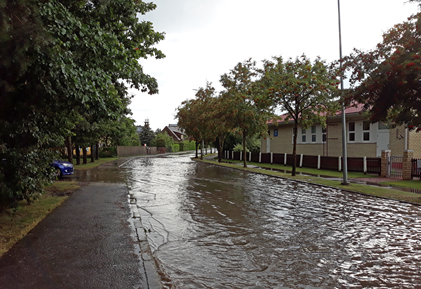
Flood in Haapsalu (Estonia), one of the partner cities of the NOAH project. Photo by Nils Kändler.
Drainage system planning support system
Urban areas can be prepared for floods through better planning and risk analysis. Coming from six Baltic countries, the participants of the NOAH project team representing universities, research institutions, municipalities, waterworks companies, and associations worked on mitigating flood risk in the Baltic Sea region. The project experts developed new tools for urban stormwater management.
In NOAH, which ran from 2019 to 2021, eight pilot areas were selected for testing and implementing control measures, monitoring tools, and planning methods in urban environments. Models of these areas were created to perform flood risk analyses. Based on the knowledge gathered during the modeling process, appropriate drainage control devices were installed to improve the monitoring and regulation of drainage systems. Furthermore, to enhance spatial planning, a new methodology for examining flood hazards in accordance with selected climate scenarios was established. A tool based on extreme weather events – the Extreme Weather Layer (EWL) – combines stormwater management with spatial planning.
In Słupsk, the study area encompassed the sewerage network operated by Wodociągi Słupsk, located in the most densely built-up terrain, where both a combined sewerage system and a separate sewerage system exist. Just before the main pumping station (which functions as the outflow in the pilot region), there is an overflow that directs excess wastewater into the Słupia River. The pilot area is the main source of inflow to the Wastewater Treatment Plant (WWTP), of which 30% consists of rainwater. The utilization of the EWL made it possible to identify the areas most at risk of localized flooding.
Benefits for the entire Baltic Sea Region
The implementation of NOAH actions and tools can reduce the inflow of pollutants from urban areas into the Baltic Sea by up to half. During the project, the EWL tool was tested and adapted to the urban planning procedures of the partner cities. The NOAH concept can be easily scaled to any urban area around the Baltic Sea, meaning it can become an element of activities in the daily practices of cities and waterworks utilities.
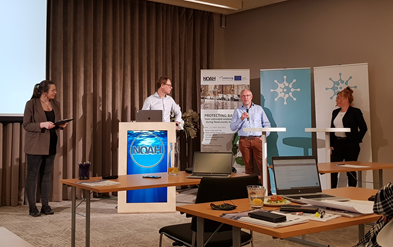
NOAH experts during the project closing seminar, November 23, 2021.
Photo by Katrin Kaur.
NOAH – a project financed by the Interreg Baltic Sea Region fund
- NOAH “Protecting the Baltic Sea from untreated wastewater spills during floods in urban areas”;
- 18 partners from 6 countries, Polish project partners: Gdańsk University of Technology, Wodociągi Słupsk, “Wodociągi Polskie” Economic Chamber;
- Lead partner: Tallinn University of Technology;
- Duration: January 1, 2019 – December 31, 2021;
- Project website: samk.fi/noah
- Project website in Polish: https://noah.igwp.org.pl/
- NOAH Handbook: https://sub.samk.fi/noah_handbook_30112021/
Contact details:
Project Coordinator: Ivar Annus
Tallinn University of Technology, Estonia
ivar.annus@taltech.ee
IGWP Coordinators:
Klara Ramm k.ramm@igwp.org.pl
Iwona Włodarek i.wlodarek@igwp.org.pl
Project Communication Manager: Hanna Rissanen
Satakunta University of Applied Sciences, Finland
hanna.rissanen@samk.fi